Prof. Dr. Bekir Taner Dinçer is one of the few voices who look at artificial intelligence from a different angle; he may irritate you at first, but once you listen closely you see that he puts his finger on the right spots. In one of the conversations he took part in, he describes a new kind of fatigue among software developers: “AI brain fry”, mental burnout caused by AI. We knew that overwork tires the mind; this is something else.
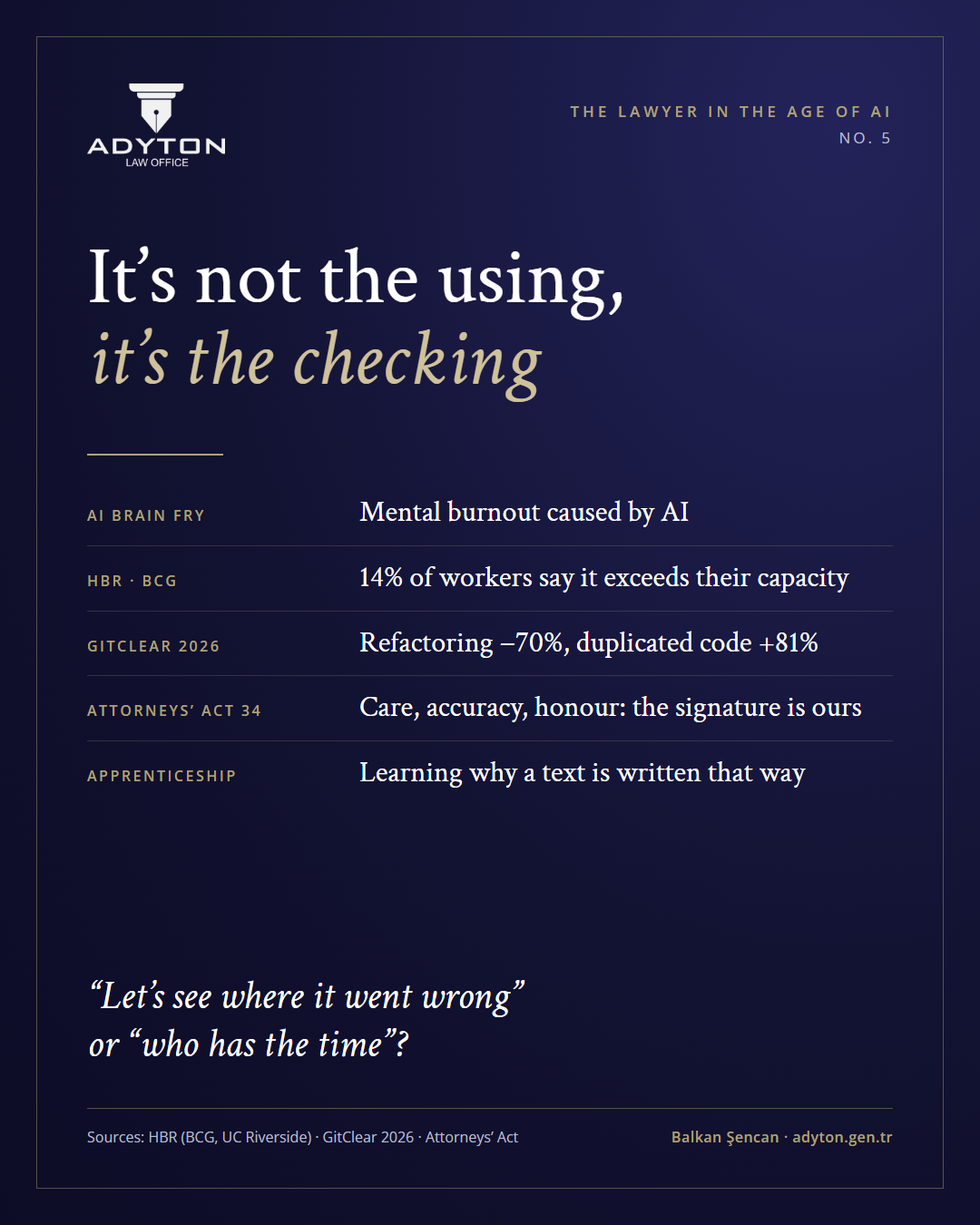
The concept rests on a study by researchers from BCG and UC Riverside, published in Harvard Business Review. Of roughly 1,500 full-time employees in the United States, 14% say that using AI, and above all checking its output, exceeds their mental capacity. What wears people out most is not using it, but checking it!
Listening to what was said about software, I realised that these are in fact shared problems of every profession that works with AI, law included; more importantly, I realised that I had been living through them myself.
First, we are moving from producing to supervising. More often than not, we no longer write the petition; we read what the AI has written. Yet the responsibility is still ours. Article 34 of the Turkish Attorneys’ Act requires us to carry out our work “with care, accuracy and honour”; the signature under the petition is ours, not the AI’s. What is more, checking a text we did not build ourselves is more tiring than writing it: we do not know where the error might be.
The second point is “invisible debt”. In software this is called “technical debt”: code produced quickly, swollen by copy and paste, that no one tidies up. According to GitClear’s 2026 report, which examined 623 million changed lines of code, refactoring has fallen by 70% compared with 2023, while duplicated code blocks have risen by 81%. We have started to see the legal equivalent: long, repetitive petitions that no one reads from start to finish, and citations to case law that never existed. This debt is paid one day, of course; usually at the hearing, at the worst possible moment.
Third, the relationship between master and apprentice. A trainee lawyer used to learn by writing petitions and seeing a senior colleague’s red pen. Now the AI writes the draft. A young colleague can produce senior-looking text in a single day, but misses the chance to learn why that text was written the way it was.
When we run several AI models together, one model’s false premise can be accepted and amplified by the others without question. If the human checking them is tired, the error travels all the way down the chain. The volume of work we produce has grown enormously; but coping with the mental fatigue it brings is just as hard.
So what should we do? Adapting the suggestions from the conversation to our profession:
- Work intensively with AI on no more than two or three files at a time.
- Set aside separate, rested time for review.
- Every day, write at least one piece of work entirely ourselves: a section of a petition, or a legal opinion.
Here is a simple test: when AI hands you a piece of work, do you read it asking “let’s see where it went wrong”, or do you say “who has the time” and sign it, or send it to your client? If it is the latter, it is time for a break.
Sources
- Random Talks Academy, conversation with Prof. Dr. Bekir Taner Dinçer (8 October 2026) (in Turkish)
- Harvard Business Review “AI brain fry” study (BCG and UC Riverside, March 2026), Axios coverage
- GitClear, Write-Only Mode: AI Code Quality in 2026
- Attorneys’ Act No. 1136, Article 34 (official Turkish text)
Originally posted on LinkedIn.