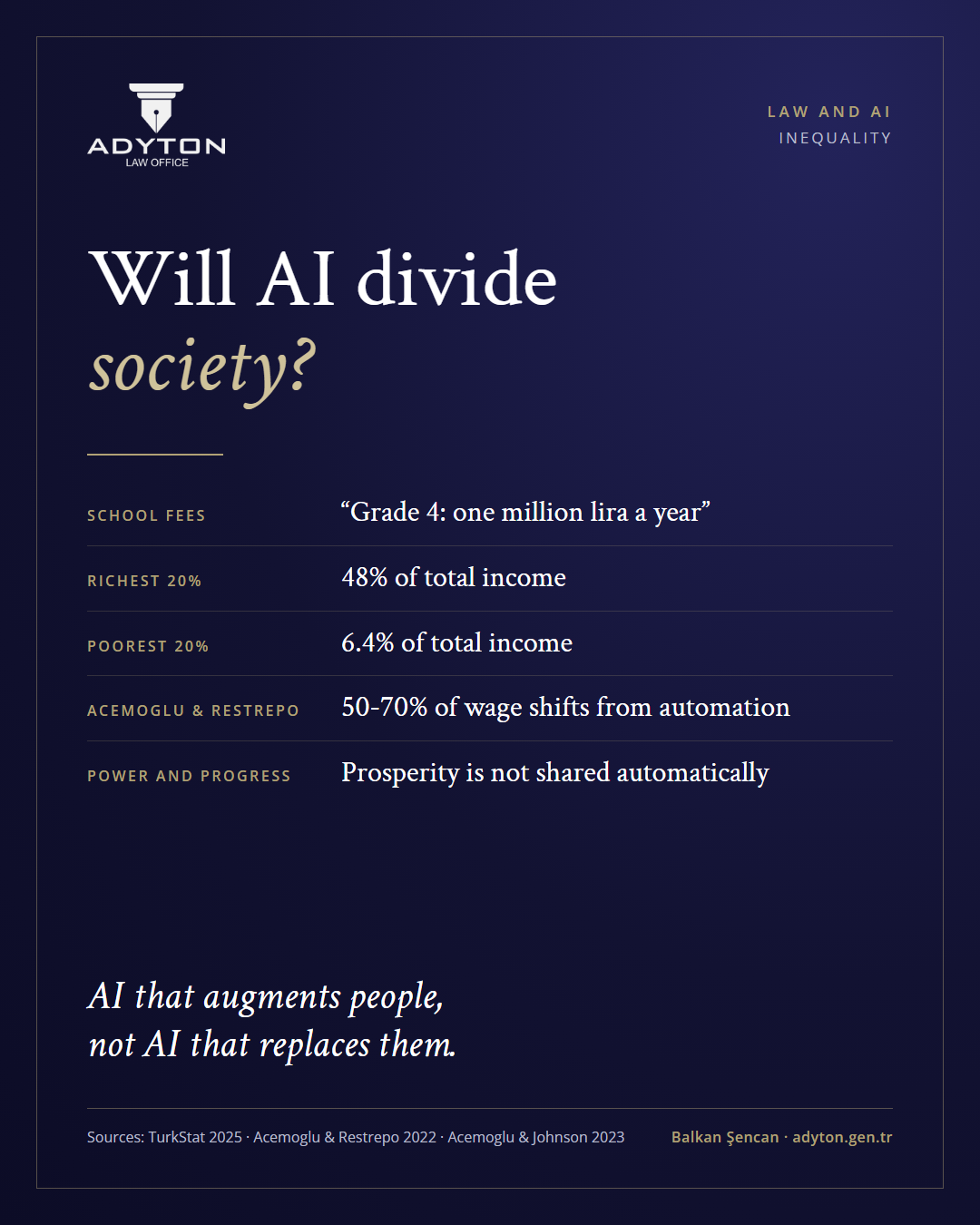
Last week a news site asked parents on the street what they pay for their children’s schooling. The answers: “Grade 4: one million lira a year.” “For two children: 1.5 million.” “University: 25,000 dollars a year.” One parent said they had spent 220,000 lira on books alone. Many of us are in a similar position.
In the comments under the video, the shared view, rightly in my opinion, was this: in Turkey, children are sorted into two separate classes as early as kindergarten. The children of the well-off receive the best education, while the great majority worry whether their child will make it home from school in the evening without being bullied.
Some call this “class resentment”; I see it differently. In these lands, hostility towards wealth earned honestly has never taken root. But those who made unjust gains out of thin air or from the public purse have never found acceptance in the public conscience either; the recent investment fund scandal is another example. Our people are angered by injustice.
The numbers confirm this anger. According to the Turkish Statistical Institute, the richest 20% receive 48% of total income, while the poorest 20% receive 6.4%. The effects of AI will soon be added to this picture.
According to a study by Daron Acemoglu, one of those who have thought hardest about this question, and Pascual Restrepo, 50 to 70% of the change in the US wage structure over the last forty years stems from automation. And according to “Power and Progress”, which he wrote with Simon Johnson, technological progress does not share prosperity fairly on its own; the shares are decided by those who set the direction of technology. With AI, too, the gap between capital income and labour income is expected to widen.
A family with money will give its child the best AI tools alongside the best school; the child of a low-income family will go without. If companies use AI not to strengthen workers but to replace them, they will also take the additional prosperity.
The irony is this: most white-collar workers, including us lawyers, fail to see that in the face of giant companies empowered by AI, we are no different from blue-collar workers. The only difference between someone who picks up an Americano from a third-wave coffee shop and spends eight hours in front of a monitor and a miner swinging a pickaxe is the physical effort they expend.
But the question can also be seen from another angle. Used well, AI can give a student at a provincial school, or a teacher working with low-income students, educational opportunities they could not normally reach. A young colleague can close the gap in knowledge and experience with large law firms far more quickly. In Acemoglu’s words, “pro-worker AI”: technology that augments people’s capabilities rather than replacing them.
The direction will first be set by those who develop and use the technology; then the legislator and we lawyers will step in. The right of access to education, a one-off windfall tax on those who become extraordinarily rich through these technologies, and the alignment of AI with human values and safety rules: how these mountain-sized questions are regulated will be our work.
For lawyers who adapt to the new era, the work will not shrink; it will grow and change.
Sources
- Turkish Statistical Institute – Income Distribution Statistics 2025, reported by Bloomberg HT (in Turkish)
- Acemoglu & Restrepo, Tasks, Automation, and the Rise in U.S. Wage Inequality (Econometrica, 2022)
- Acemoglu, The Simple Macroeconomics of AI (2024)
- Acemoglu & Johnson, Power and Progress (2023)
- Acemoglu, Autor & Johnson, Building Pro-Worker AI (2026)
Originally posted on LinkedIn.