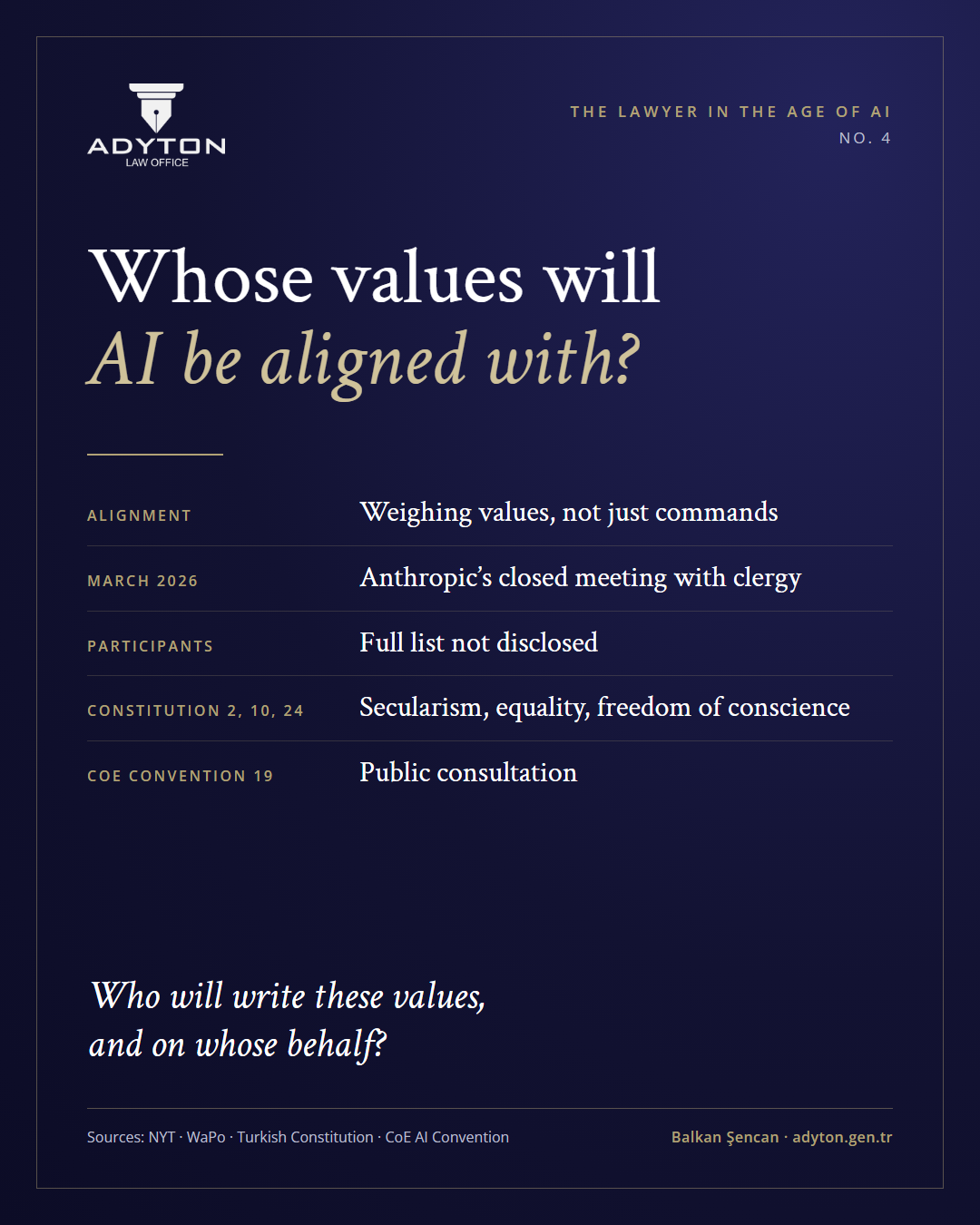
One of the most talked-about concepts of recent times is “alignment”; its opposite is “misalignment”. In short: rather than executing a command word for word, an AI system should first weigh whether the command and its outcome are consistent with human values and safety rules, and act accordingly. For example, when you say “I’m out of money and in a tight spot, what can I do?”, it should not try to hack a bank; nor should an autonomous car, to save its own driver from a crash, steer into a family coming the other way.
The question, then: whose values will be taken into account in alignment? When we speak of an AI’s “conscience”, whose conscience do we mean?
News leaked to the press that in March 2026 Anthropic, the developer of Claude, held a closed two-day meeting with around fifteen clergy and academics to discuss the moral standards its model should follow. According to The New York Times, the conversations did not stop there; among the roughly twenty people it spoke to were Catholic, Evangelical, Jewish and Sikh figures, as well as voices from the Ubuntu philosophy. The full list has not been disclosed.
Religion and nationality are two of the most fundamental elements of our identity. If religious sensitivities are to be taken into account, and I agree they should be, will the sensitivities of nations, or of UN member states, be considered too? If so, which ones, and how far?
Still, Anthropic is making an effort; it has also published the document setting out Claude’s values. But the yardstick by which a system consulted by millions defines “good” and “right” is still being shaped in a few meeting rooms.
Besides, almost all frontier models come from US and Chinese companies, and their values come first. A model that respects our own values can only be trained by hands that know our language, our law and our culture.
Our Constitution declares the state secular, guarantees freedom of religion and conscience, and treats everyone as equal without distinction of religion or sect (Turkish Constitution, Arts. 2, 10 and 24). A secular state keeps an equal distance from all beliefs. An AI used by everyone should do the same: it should know beliefs and respect them, but make none of them its own identity.
In its March 2026 report, the Turkish Parliament’s Artificial Intelligence Research Commission recommended a dedicated AI law and a Turkish Artificial Intelligence Authority. But there is a familiar habit in our country, summed up in the Turkish saying “yok kanun, yap kanun”: whenever a problem arises, the reflex is to pass another law. Laws are drafted in a narrow circle and enacted quickly; practitioners and civil society hear about them afterwards. Yet the Council of Europe Framework Convention on Artificial Intelligence, which the commission recommends signing, has an article titled “Public consultation” (Art. 19).
AI is too broad a field to be regulated this way. It needs a process in which everyone has a say, from engineers to doctors and from lawyers to clergy, both those who develop the technology and those affected by it. The issue is not only technical; it is a matter of justice, conscience and human dignity.
As we try to align machines with human values, we must first ask ourselves: who will write these values, and on whose behalf? Our task as lawyers is to take a seat at that table; otherwise we will be nothing more than extras in a script written on our behalf.
Sources
- The New York Times, “Religious Scholars Met With Anthropic. What They Heard Stunned Them.” (29 September 2026)
- The Washington Post, “Anthropic asked Christian leaders for advice on Claude’s moral future” (11 April 2026)
- Anthropic, “Widening the conversation on frontier AI” (19 May 2026)
- Turkish Parliament, Artificial Intelligence Research Commission (in Turkish)
- Council of Europe Framework Convention on Artificial Intelligence
- Constitution of the Republic of Türkiye, Articles 2, 10 and 24 (official Turkish text)
Originally posted on LinkedIn.