In this two-part series, we first looked at the world; now it is Turkey’s turn.
The picture we saw on Thursday was this: lawmakers want AI output to be distinguishable, but they keep pushing back the timetable for the heavier obligations. Today, let us bring the same question to our own table.
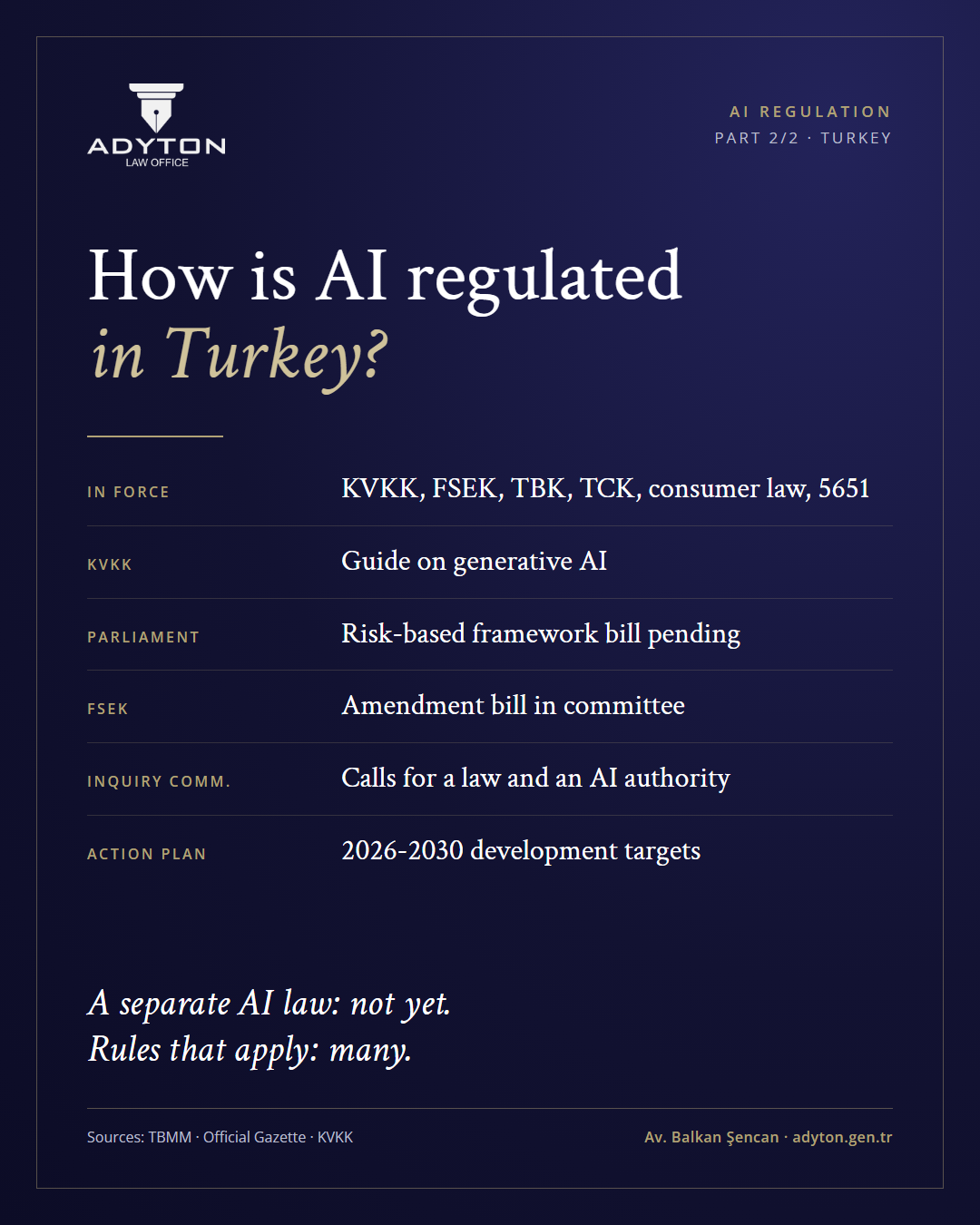
Turkey has no separate law regulating AI. But this is not a gap; it is fragmentation.
The Personal Data Protection Law No. 6698 (KVKK) for personal data, the Law No. 5846 on Intellectual and Artistic Works (FSEK) for works, and the Turkish Code of Obligations for liability already apply. Alongside them stand the Turkish Criminal Code, the Consumer Protection Law and Law No. 5651 on internet publications. The generative AI guide published by the Personal Data Protection Authority in November 2025 and its workplace announcement of March 2026 are not laws, but they show how Law No. 6698 applies to these tools. For Turkish companies placing AI systems on the EU market, the EU AI Act applies to those systems whether or not a law is passed here.
There is movement towards new rules, too. In the Turkish Grand National Assembly, a risk-based framework bill similar to the EU’s (2/2234), bills calling for labels on deepfake content, and a bill of April 2026 amending FSEK (2/3634) are pending in committee; none has become law. The report of the Parliamentary Inquiry Committee of March 2026 recommended a separate law, a Turkish Artificial Intelligence Authority and ratification of the Council of Europe Framework Convention. The 2026-2030 Action Plan, published on 18 August 2026, sets targets such as 10,000 advanced specialists and 1 GW of data centre capacity. The report is a recommendation and the plan is a development document; neither is a law creating rights and obligations.
So what should we do? My view is this:
Let us regulate, but not with the “no law, make a law” reflex, through a text drafted in a narrow circle and passed in a hurry. Even the EU had to pull back, this year, the heavy timetable of the regulation it adopted two years ago.
Transparency should come first: people should be able to tell that the content in front of them was produced with AI, and deepfakes should be marked. The rules for high-risk uses, on the other hand, should come with broad consultation and a reasonable timetable.
An FSEK exception for AI training should not be rushed. Rightsholders should come to the table knowing their rights.
And the table should be a wide one: engineers, doctors, software developers, rightsholders, public officials and, of course, lawyers. A lawyer’s place is not in the assessment note written after the text is passed; it is the chair at the table while the table is being set.
Finally, supporting models that know Turkish and our law should be part of this regulation. Being able to set our rules with our own participation and in our own language is also a matter of sovereignty.
What do you think: should a separate AI law come first, or should the existing fragmentation be put in order?
Sources
- Turkish Grand National Assembly, Bill No. 2/2234 on Artificial Intelligence
- Turkish Grand National Assembly, Bill No. 2/3634 amending FSEK
- Report of the Parliamentary Inquiry Committee on Artificial Intelligence, March 2026 (in Turkish)
- Turkey’s Artificial Intelligence Action Plan 2026-2030, Presidential Circular No. 2026/9 (Official Gazette, 18.08.2026) (in Turkish)
- KVKK, Guide on Generative AI and the Protection of Personal Data (in 15 questions) (in Turkish)
Originally posted on LinkedIn.