In this two-part series, we look first at the world, then at Turkey.
A news story from August may have caught your attention: when we now ask Claude to write a text, an invisible mark is added to it showing that it was written by AI. The reason is not a rule Anthropic set for itself, but a European Union regulation.
Article 50 of the EU AI Act requires the output of generative systems (text, images and so on) to be marked so that, when read by another machine, it can be recognised as AI-generated. This provision has applied since 2 August 2026.
Anthropic adds an invisible watermark to text and C2PA provenance information to images, and it does so not only in the EU but everywhere in the world. However, the mark only shows that a text may have been processed by Claude; its absence does not, on its own, prove that a text was written by a human.
In other words, an EU rule now shapes how the product works worldwide. So what does the overall picture look like?
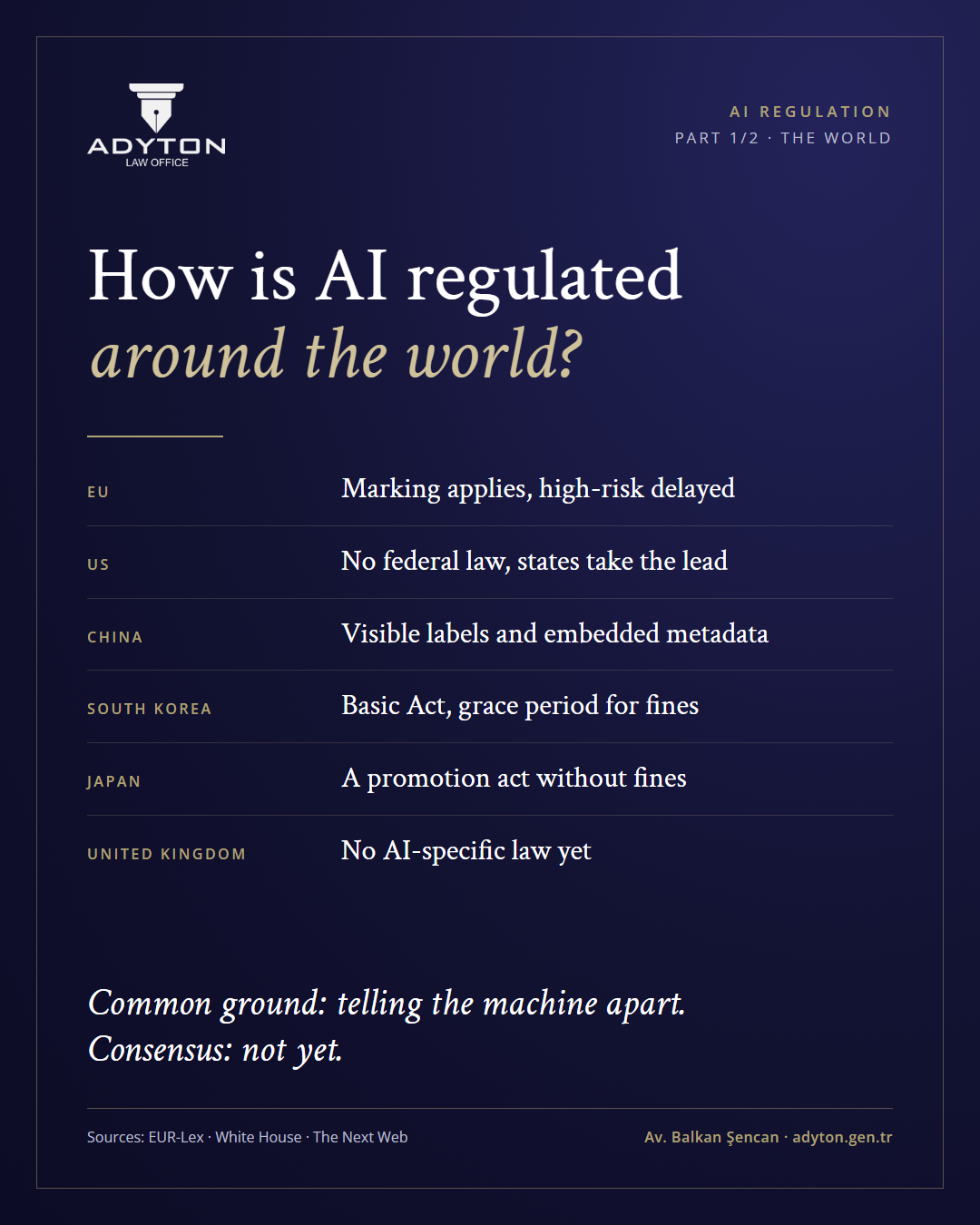
The EU is moving forward with a single, directly applicable, risk-based regulation. Its prohibitions have been in force since 2025, and systems that generate intimate images without consent or child sexual abuse material will also be prohibited from 2 December 2026. For high-risk systems, however, the timetable has been pushed back: under the Digital Omnibus of July 2026, obligations in areas such as recruitment and credit scoring were postponed to 2 December 2027, and those for systems embedded in products to 2 August 2028. For systems used by public authorities, the deadline extends to 2 August 2030.
The United States has no federal law regulating AI. States are putting their own rules into effect; California’s SB 53, which brings transparency requirements to frontier models, has largely been in force since 1 January 2026. The federal administration, meanwhile, opposes state regulations that restrict AI development. Colorado, for its part, repealed its comprehensive law before it took effect and replaced it with a narrower one. The debate is shifting from “how should we regulate?” towards “who will regulate?”.
Since September 2025, China has required visible labels and embedded metadata so that AI-generated content can be identified. South Korea’s AI Basic Act entered into force in January 2026, with a grace period of at least one year for fines. Japan is proceeding with a promotion act that provides for no fines. The United Kingdom does not yet have an AI-specific law.
One conclusion seems fair: lawmakers want AI output to be distinguishable from work produced by human effort alone. But no country wants its own users and developers to fall behind, so they are reluctant to attach sanctions to the risks and keep pushing back transition timetables. There is no global consensus yet on how this field should be regulated.
In our next post we will look at Turkey. Turkey does not yet have a separate AI law, but that does not mean there are no rules.