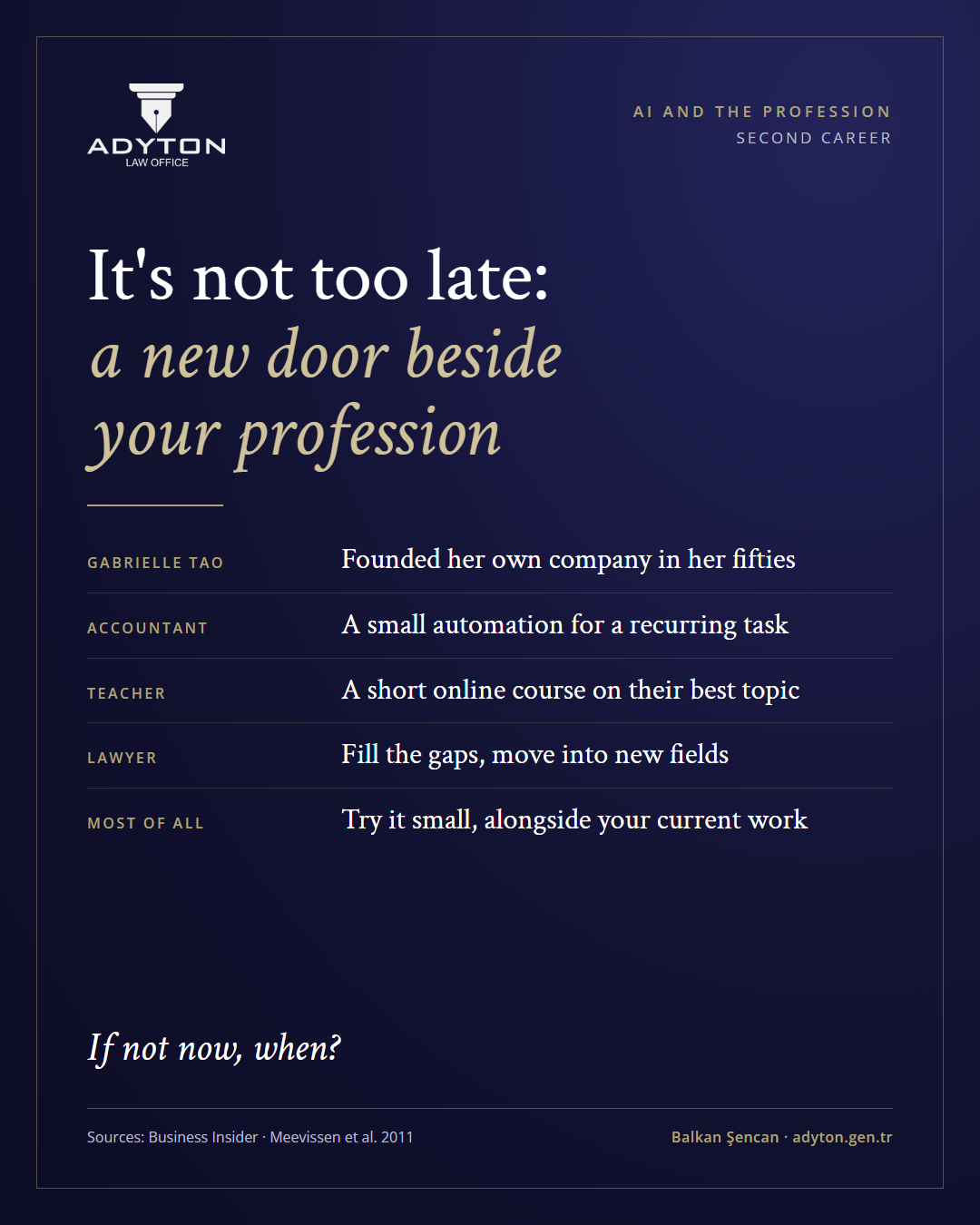
“Leaving a stable job was scary.” “If not now, when?”
Those words are Gabrielle Tao’s. After more than twenty years in tech, in her fifties, she left her senior vice president role at Salesforce and founded her own company in the field of artificial intelligence. By her own account, she spent years believing entrepreneurship wasn’t for “someone like me”; what changed her mind was AI. Today she says one tool often feels like having “an architect, engineering team, and product manager all in one”.
We are not concluding from this story that everyone should quit their job, of course. Before leaving, Tao worked through her budget and savings; she supports family members, and after she left, they cut back on spending. Although she believes she prepared well financially, she says: “I wish I had planned the actual business and product more deeply before leaving my job.”
Many of us can see this: life expectancy and working life have both grown longer, and economic conditions have become harder. In middle age, creating a new line of work, a new source of income, beside or instead of the profession and education we have acquired so far is on many of our minds.
I have been practising law independently for twenty-five years; along the way, after working as a court-appointed expert and a conciliator, I added first mediation and, this year, AI training. Not instead of law, but beside it. The future frightens everyone, yet it also holds opportunities. Developments in AI do not throw my professional experience away; they enrich how I see the profession and how I practise it.
I can share this personal thought with my contemporaries, whatever their professions: it is never too late. Many people are gnawed at by the questions “Should I move to another line of work? If I do, what happens to my income?” That worry is justified, but AI is also bringing within reach opportunities that did not exist until just two or three years ago.
In a study shared on X by Rishabh Karnawat, participants spent five minutes a day for two weeks imagining their “best possible self”, including in their professional lives; their optimism increased more than that of the control group. The measure rests on self-report, but the first step sometimes begins with making that picture clear in the mind.
For example:
- An accountant can try a small automation tool that eases a task repeated every month.
- A teacher can turn the topic they explain best into a short online course and test it with a few people.
- We lawyers can more easily build up our knowledge where we fall short and move more comfortably into new fields.
- Most importantly: we can try the new work on a small scale, alongside our current work, and plan our time, savings and family responsibilities from the start.
Of course AI opens this door, but walking through it and taking responsibility still falls to us. Worrying is natural. But what worry outweighs the regret we may feel later on? All we have to do is set aside a little time to reflect on this and find the courage to take that first step; I don’t think it is hard at all, and the time is right. Perhaps give it some thought.
Sources
- Gabrielle Tao, as told to Jacob Zinkula, “I spent over 20 years in tech thinking entrepreneurship wasn’t for someone like me. AI changed my mind.”, Business Insider via Yahoo (5 June 2026)
- Rishabh Karnawat on X (27 October 2026)
- Meevissen, Peters & Alberts, “Become more optimistic by imagining a best possible self: effects of a two week intervention”, Journal of Behavior Therapy and Experimental Psychiatry 42(3), 2011, pp. 371-378
Originally posted on LinkedIn.