Let us remember December 2024. The voice of Prof. Dr. Ömer Özkan of Akdeniz University was cloned with AI, a social media account was opened in his name, and he was shown praising a cream said to cure every kind of pain and make surgery unnecessary. The video was watched hundreds of thousands of times. He filed a criminal complaint and said he saw many gaps on the legal side.
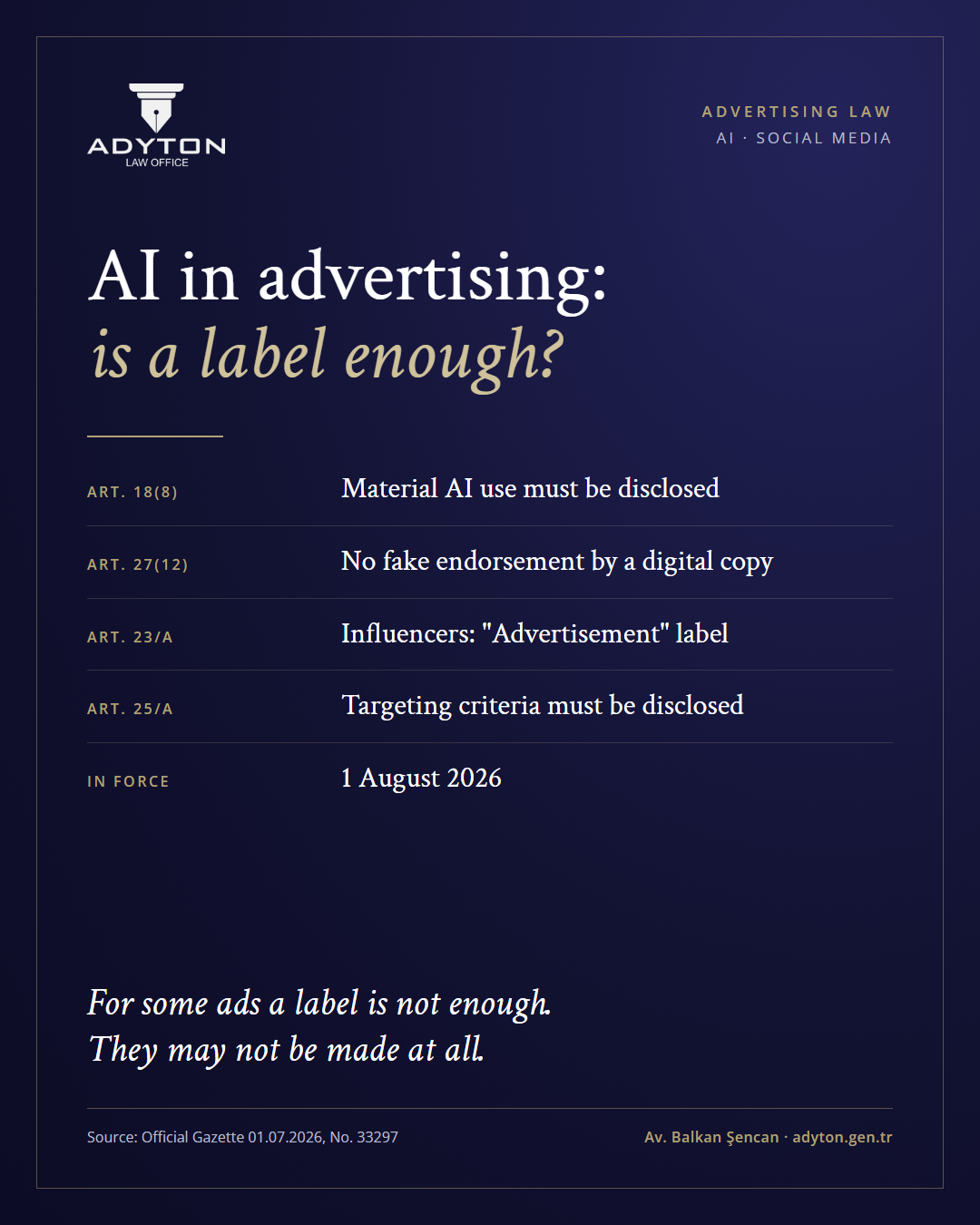
One of those gaps, at least in advertising law, closed on 1 August 2026. The amendment to the Regulation on Commercial Advertising and Unfair Commercial Practices (Official Gazette, 01.07.2026, No. 33297) entered into force one day before the labelling rule of the EU AI Act.
Under the new rules (Art. 18(8)), where AI or other software is used in an advertisement in a way that materially affects the consumer’s economic behaviour, or where digital characters created with AI that cannot be distinguished from humans are featured, this must be stated clearly, understandably and distinguishably. Not every advertisement needs a label just because AI was used; the criterion to watch is “materially affects”.
A prohibition came as well (Art. 27(12)). An AI-generated digital copy of a real person may not be shown as having personally tried, used or recommended a good or service, contrary to the truth. Even if you write “generated with AI” underneath, such an advertisement may not be made.
The rules for influencers are now set out in the Regulation too (Art. 23/A). A post made in return for a benefit must say “Advertisement” (Reklam) or “Promotion” (Tanıtım), together with the advertiser’s name or one of the “provided by” type statements listed in the Regulation. We will not have to scroll down to find this label; it must come before other tags, and in audio content the information must be given at the start.
In targeted advertising, too, they must tell us by which criteria they show us an ad and how we can change them (Art. 25/A). Targeted advertising based on profiling of personal data is prohibited for anyone known, or expected to be known, to be a child.
AI-generated advertising was supervised before, too. In September 2023 the Advertising Board sanctioned three promotions prepared with ChatGPT under the general rules. The new Regulation, however, brings an AI-specific disclosure duty and a digital copy ban. I have not yet come across a published Board decision based on these provisions.
Of course, a provision in a regulation will not stop a fraudster; that is a matter for criminal law. But for advertisers, agencies and media, the basic criteria are now clear. We have said that Turkey has no separate AI law and that its rules are scattered. This is one of those rules, and it is worth paying attention to.
Sources
- Regulation Amending the Regulation on Commercial Advertising and Unfair Commercial Practices (Official Gazette, 01.07.2026, No. 33297; in force 01.08.2026) (in Turkish)
- Ministry of Trade announcement on the amendment (in Turkish)
- DHA, 21.12.2024: the fake cream video using Prof. Dr. Ömer Özkan’s cloned voice (in Turkish)
- Advertising Board sanctions on promotions prepared with ChatGPT (AA, 13.09.2023, via Cumhuriyet) (in Turkish)
Originally posted on LinkedIn.