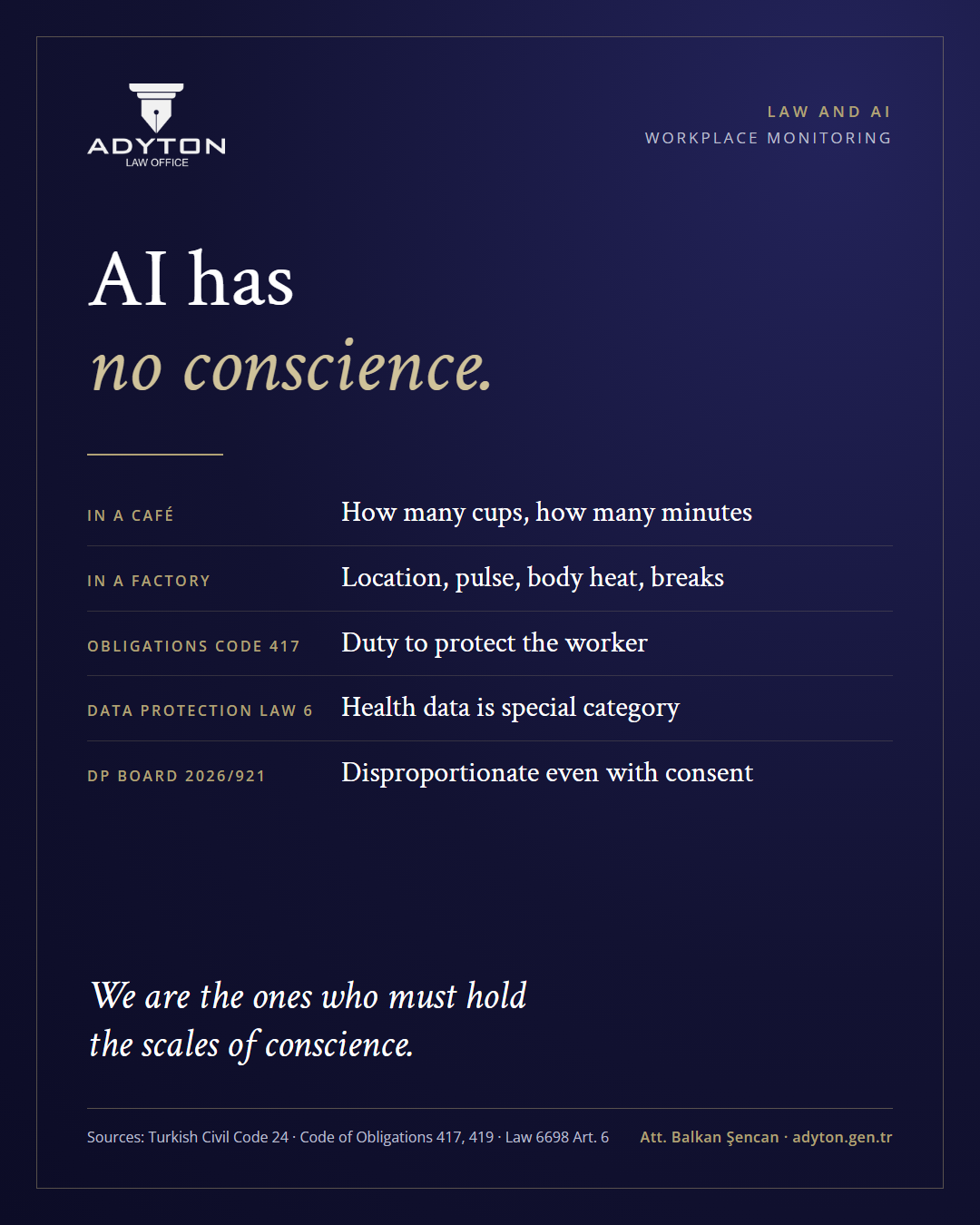
We keep talking about the speed, efficiency and convenience of artificial intelligence. But the other side of the coin has begun to show.
We had been seeing examples abroad for some time. In a video circulating on social media since 2023, AI-assisted cameras in a coffee shop counted how many coffees each barista prepared and how many minutes each customer spent at their table. The customer’s minutes at the table and the barista’s performance had both become ruthless units of measurement for maximising profit. How many minutes does the average customer sit? How many coffees does the average barista make per minute?
In a café people chose for its warm atmosphere and its staff, they had suddenly become cogs in a ruthless industrial machine. I did not expect this to reach Turkey so quickly, or so harshly.
A few days ago, it was reported that workers at a factory in Ankara had chip-enabled cards hung around their necks. The cards track each worker’s location in real time and measure body temperature and heart rate; breaks, meals and toilet visits are recorded. The company cites safety; the workers see it as a tool of pressure. One worker summed it up in a single sentence: “They hang it around our necks like a collar.”
So what does Turkish law say?
Article 24 of the Turkish Civil Code protects personality rights against unlawful interference. Article 417 of the Turkish Code of Obligations places a clear duty on the employer to protect the employee’s personality and to respect it; damage arising from a breach of personality rights is compensated under the rules on breach of contract. Under Article 419, the employer may use an employee’s personal data only to the extent that it relates to the employee’s suitability for the job or is necessary for the performance of the employment contract. Heart rate and body temperature are health data under Article 6 of the Personal Data Protection Law — special categories of personal data whose processing is, as a rule, prohibited.
In its principle decision of 29 April 2026, the Personal Data Protection Board found that using fingerprints or facial recognition merely to track working hours is disproportionate, even with the employee’s explicit consent: less intrusive means such as cards or PIN codes exist, and the imbalance of power between employer and employee deprives consent of its freedom. In June, the Personal Data Protection Authority also announced that using cameras “to see whether employees are working efficiently” cannot be regarded as a legitimate purpose. A collar that measures heartbeats would struggle to pass that test.
What I want to stress is this: it was not AI that hung these devices around workers’ necks. An employer decided, a manager implemented it; perhaps the company’s legal adviser approved it. No one asked: “Is this proportionate? Is it conscionable? Is it worthy of human dignity?”
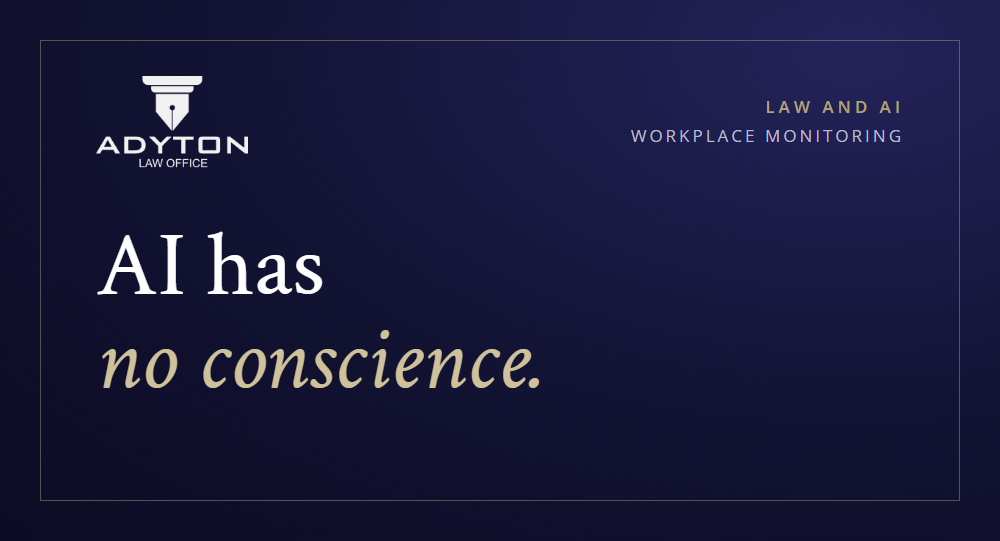
AI has no conscience. It counts the cups a barista prepares and calculates their monetary value; it measures breaks and records heartbeats. But it does not weigh whether any of this is compatible with human dignity, or with our conscience. We are the ones who must use that scale: the people who build AI models, use them and review their lawfulness.
One of the duties that falls to us as lawyers is to make sure this question is asked: not to obstruct technology, but to steer it with our own conscience. As these systems enter more and more workplaces, our opinion will often be sought as legal advisers; at that moment, what we must not forget is our conscience and our basic standards of humanity. If we do not want to become servants of intelligent machines, we must use the discretion in our hands when the moment of decision comes before us. That is the only way to keep ourselves from becoming worthless and irrelevant.
Sources
- İlke TV report of 5 October 2026 (in Turkish) – chip-enabled tracking cards at a factory in Ankara
- Upworthy – coffee shop AI monitoring video
- Personal Data Protection Board, Principle Decision No. 2026/921 of 29 April 2026 (in Turkish) – biometric data for working-time tracking
- Personal Data Protection Authority, announcement of 8 June 2026 on workplace security cameras (in Turkish)
- Turkish Code of Obligations No. 6098, Articles 417 and 419 (official Turkish text)
- Personal Data Protection Law No. 6698, Article 6 (official Turkish text)
Originally posted on LinkedIn.