Last month I was watching a smartwatch review. In the very first minute, Michael Fisher explained that he was getting ready to leave his smartphone behind for a basic phone that only makes calls and sends and receives messages, and that he wanted to go back to a plain wristwatch that sends no notifications. I suspect that for many of us, struggling with dozens of notifications from computers, phones, tablets and smartwatches, this wish does not sound strange at all.
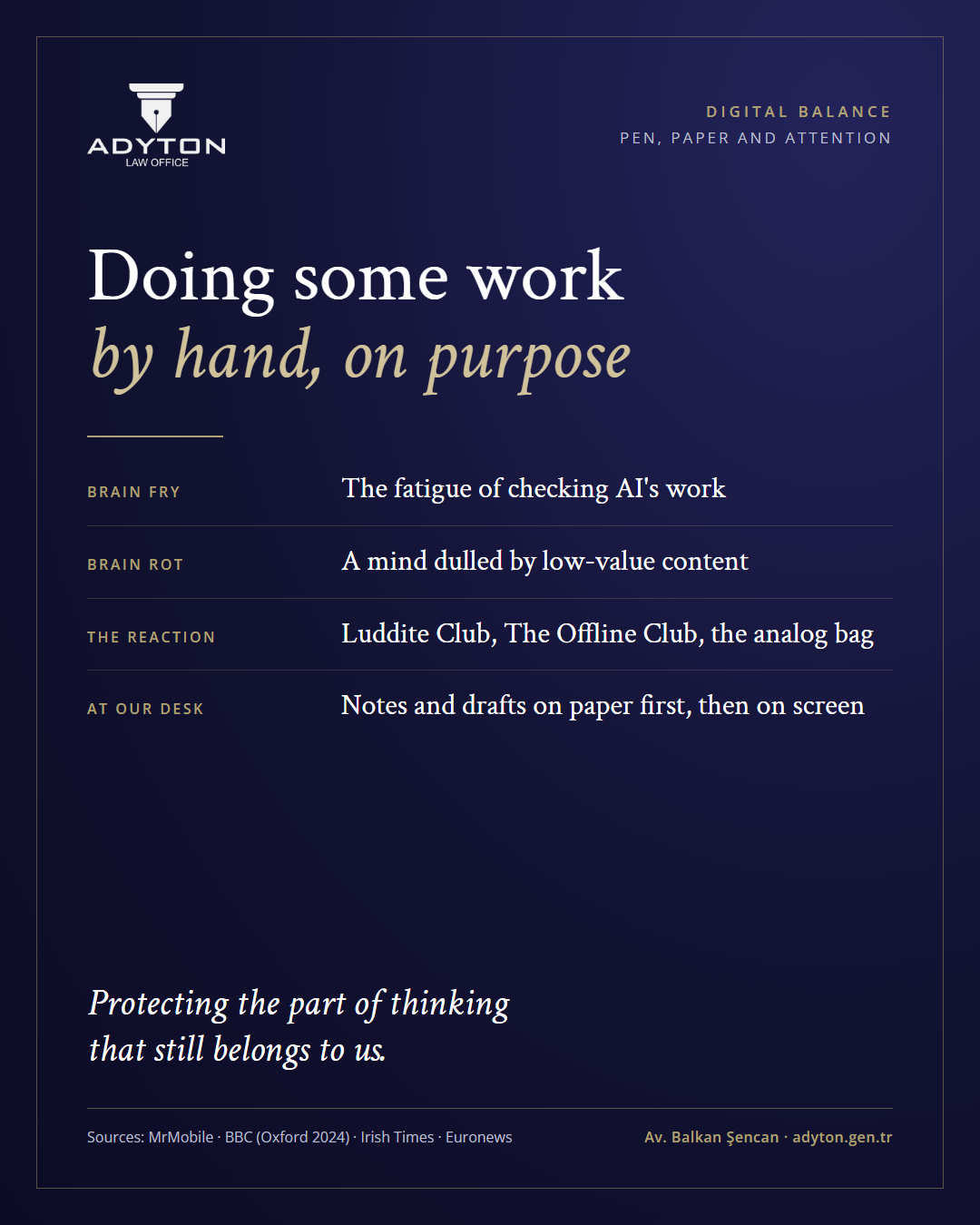
In one of our earlier posts, we wrote about the mental fatigue we feel while checking work produced by AI before sending it out: “brain fry”. “Brain rot”, Oxford’s word of the year for 2024, describes how endlessly consuming low-value online content dulls the mind. The two concepts are similar; what they have in common is that they target our attention and wear us out mentally.
Around the world, a reaction against this is growing. Members of the Luddite Club, founded by high school students in Brooklyn, have swapped their smartphones for flip phones; at their meetings they read books, draw and write. At The Offline Club, which started in Amsterdam and spread to London and Paris, phones are left at the “phone hotel” by the door, and inside people read, write and talk. Many parents are taking extra steps to keep their children away from smartphones and tablets. Some young people have started carrying a notebook and a paper planner in their bags instead of a phone.
Of course, this trend should not be overstated either. Some experts say screen time has hardly dropped, that the notebook usually sits next to the phone rather than replacing it, and that part of it is nostalgia and fashion. Still, one point matters here: people want their attention, and the time they set aside for thinking, back; they regret the empty hours spent in front of screens.
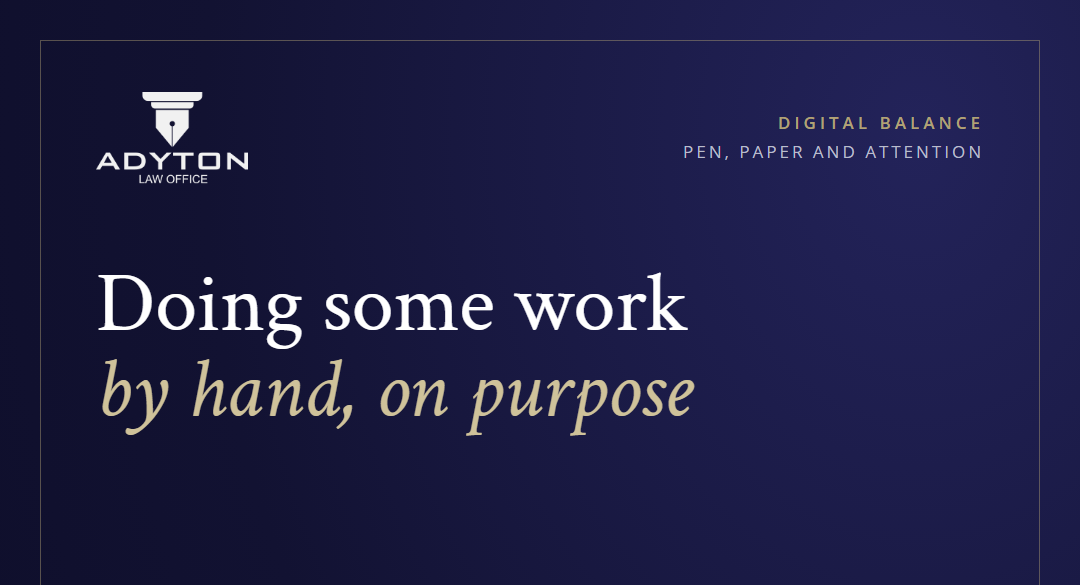
If you ask how we can carry this into our own work, I can at least say what I try to do myself. The first step is always not to give up working with pen and paper: writing the basic notes and the working draft by hand, and moving the draft to the computer only once it has taken shape. As I wrote in the earlier post, writing at least one piece of work entirely ourselves every day, with pen and paper, and working on it, is a valuable idea whose concrete benefit I have seen. Going into client meetings and Teams calls with a pen and notebook, taking notes the old-fashioned way, and only then handing them to AI tools, works the same way.
I use AI tools intensively and well in every area of my life, at work and in private, and I have no intention of giving them up. But I think that doing some work by hand, on purpose, is one way of protecting the part of thinking that still belongs to us. I would be curious to hear what you think about this.
Sources
- Our earlier post on “brain fry”
- MrMobile (Michael Fisher), Pixel Watch 5 review, opening section
- Oxford’s 2024 word of the year, “brain rot” (BBC)
- The Luddite Club (Irish Times, 2022)
- The Offline Club (Euronews)
- Gen Z and the analog turn (Fortune)
- The “analog bag” (Deseret News)
- Handwriting and EEG (Van der Weel and Van der Meer, Frontiers in Psychology, 2024)
Originally posted on LinkedIn.