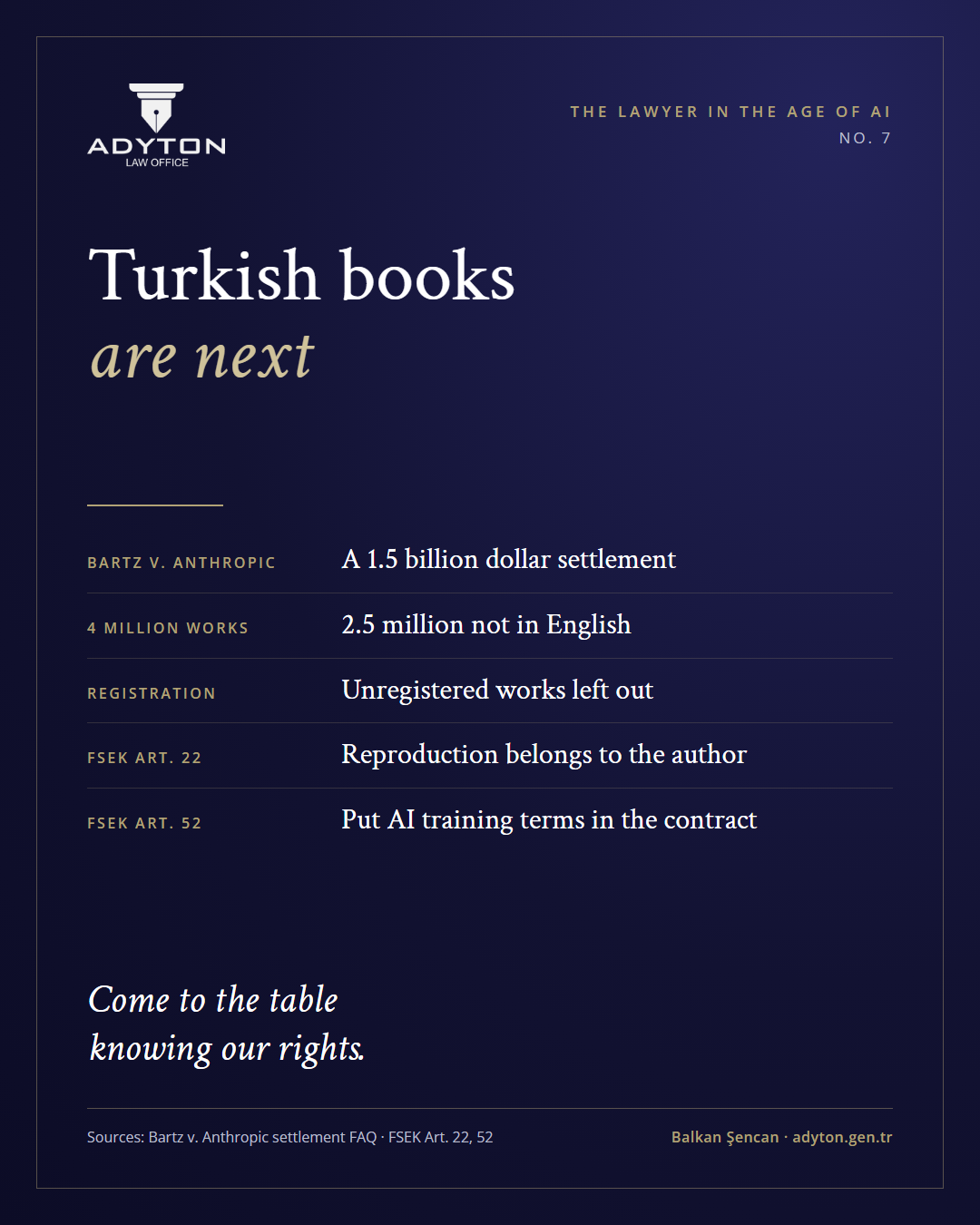
In a lawsuit filed in the United States over allegations that it downloaded books from pirate sites to train Claude, Anthropic settled with authors and publishers for 1.5 billion dollars. One could also sum it up like this: “Steal first, pay later.”
Let us look closer. In Bartz v. Anthropic, the court accepted the use of books for AI training as “fair use”, a doctrine specific to US law. It did not, however, extend that to copies downloaded from pirate libraries such as LibGen and PiLiMi, and left those for trial. The parties settled before the trial began; the settlement became final on 20 July 2026. Anthropic did not admit wrongdoing, but it undertook to destroy the copies. Nor does the settlement permit any future training.
According to the settlement’s official FAQ page, about 2.5 million of the roughly 4 million unique works downloaded are in languages other than English. Yet only works registered with the US Copyright Office in time could join the settlement; most non-English works are therefore not on the list. While roughly 3,000 dollars per work is being discussed, the owners of these works, which also leaked to pirate sites, keep their rights on paper but will receive no payment.
How many Turkish books are in that pile, we do not know.
My prediction is this: frontier models have completed most of their training in widely used languages, above all English, on which they were built. They will now devote budget, time and effort to national languages, and Chinese models will follow them. The debate we have seen over English books will, before long, reach Turkish books, articles and sources as well.
Under Turkish law, the right of reproduction belongs to the author (Turkish Law on Intellectual and Artistic Works, FSEK, Article 22); there is no separate exception for AI training or data mining. The US fair use ruling does not bind us. Which law applies if training takes place abroad is another debate.
So what can rightsholders, publishers above all, do about this? Five measures are possible:
- Inventory: Where are the digital copies of our works, who holds them and under what permission; are they circulating on pirate sites?
- Contracts: In author, publisher and translator contracts, let us write down permission or prohibition of AI training and any fee, specifying the rights one by one (FSEK, Article 52). Let us reread old contracts with this in mind.
- Reservation: Our website and e-book metadata should carry a machine-readable “text and data mining is not permitted” statement. Providers placing models on the EU market must respect such reservations; it may help even though it gives us no direct right.
- Records: Let us keep the documents showing a work’s date and ownership in order; for works sold abroad or translated into another language, let us learn that country’s registration rules.
- Acting together: Let us build a joint licensing and negotiating position through professional associations.
The point is not to oppose AI; it is to come to the table knowing our rights.
Publishers and authors: does your publishing or translation contract contain an express clause on AI training? Are you ready for AI?
Sources
- Bartz v. Anthropic settlement, official website and FAQ (especially questions 13, 15, 50 and 52)
- Law No. 5846 on Intellectual and Artistic Works, Articles 22, 38 and 52 (official Turkish text)
- Directive (EU) 2019/790, Article 4(3) (reservation of text and data mining)
- Regulation (EU) 2024/1689 (AI Act), Article 53(1)(c) and (d)
Originally posted on LinkedIn.