In a podcast I listened to today, one metaphor stuck with me: taking an “X-ray” of an accounting program. The tool under discussion was REA, “Reverse Engineer Anything”, which became hugely popular on GitHub in a short time. It connects AI coding agents to reverse-engineering tools; having an agent examine a program whose source code you have never seen, and then getting it to write a similar one for your own needs, has become very easy. The comments were quick to follow: “Software is over; everything will be open source!”
At first glance it sounds tempting, doesn’t it? Let us think about it for a moment.
In Turkey, many excellent companies founded with local capital develop software, particularly in accounting, CAD and the defence industry. If you own or work for such a company, it is hard not to shudder: What can I do if my product is cloned, and worse, if someone builds and sells their own product on top of it?
A fair question. A registered trademark usually protects only your name; a competitor can release a product that does the same job under a different name. A computer program as such cannot be patented either (Industrial Property Code, Art. 82/2).
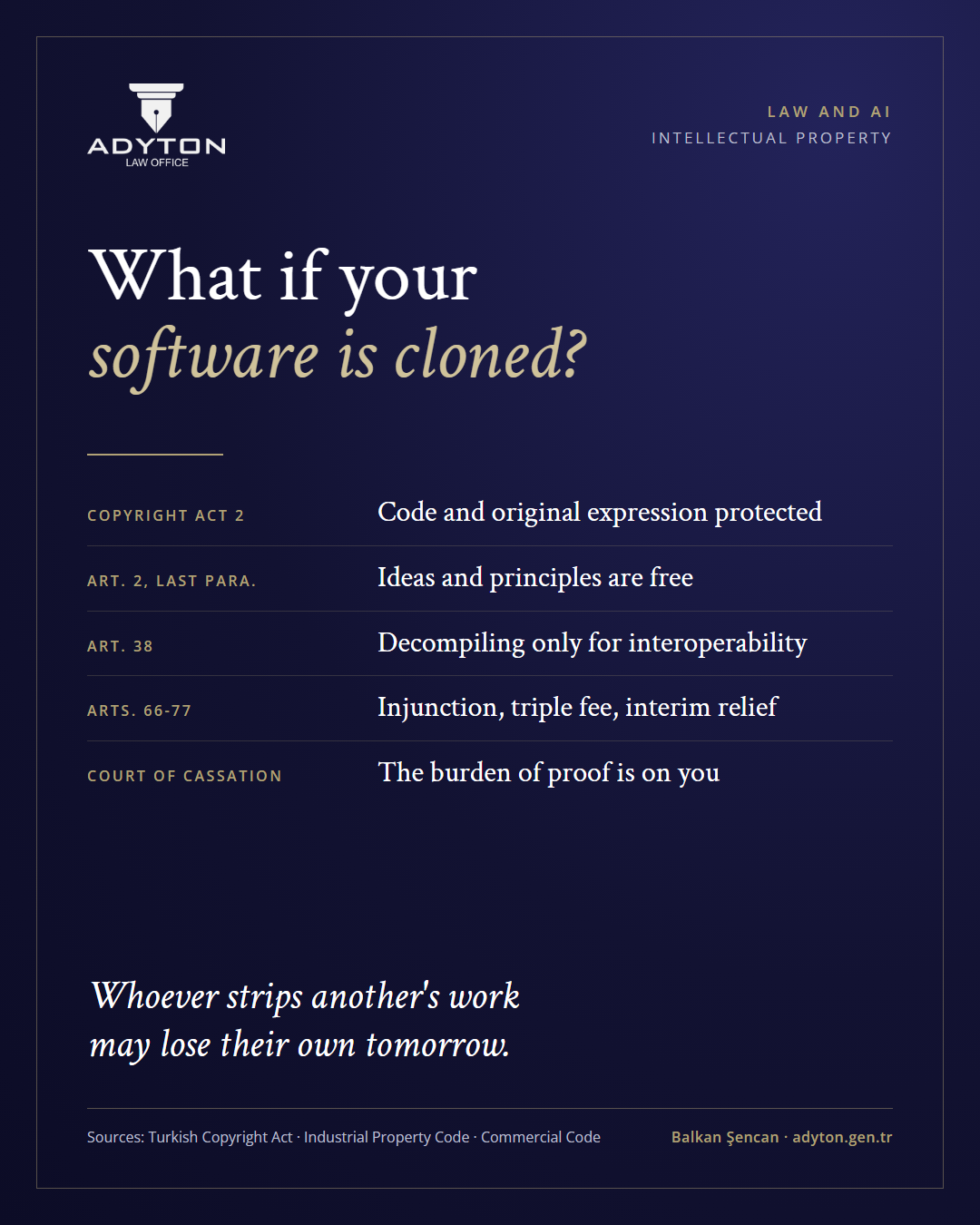
The Turkish Copyright Act offers reasonable protection. A computer program is a protected work, but the ideas and principles underlying its interface are not (Art. 2). What the program does is free; the expression of the code and of an original screen design is protected.
Our law accepts reverse engineering up to a point. A person entitled to use a program may observe how it works, but may decompile the code only to make it work with other programs, and only as far as necessary. Using that information to develop or market a program “substantially similar in its expression” is prohibited (Art. 38). Bringing AI into the process does not remove that limit.
Where there is infringement, the owner can seek an injunction, compensation of up to three times the fee that would have been payable under a licence, interim measures and, upon complaint, criminal prosecution (Arts. 66-77). But it is not all smooth sailing: the burden of proof lies with the rights holder. In one decision of the Turkish Court of Cassation, a company that could not produce its source code failed to prove its claim.
What really stays with me, though, lies beyond the law. What makes an application an application is the whole of it: the thinking, the trial and error, the hours spent with customers, the effort and toil behind it. Stripping a finished program of its skeleton and core ideas, like meat off the bone, is above all unfair to that effort.
What is more, those who do this are often people who use such software in their own work. If you use someone else’s work without paying for it, tomorrow someone else will take your idea, your product, your solution the same way, and you will have nothing to say. At the end of the day, the one who does it is not the winner but the one who shoots themselves in the foot. A customer who switches providers without thinking may lose too, because part of what we pay for is the confidence that someone will be there when something goes wrong.
AI will keep bringing new problems along with its opportunities. Our task as lawyers is to deepen our knowledge; the task of software owners is to stay calm and be prepared, together with colleagues who know this field. Only then can years of work and hard-earned effort be protected.
Sources
- REA – Reverse Engineer Anything, coverage (AI Fire)
- Barış & Barış podcast, “700 Bin Satır Kodu Yapay Zekaya Yazdırdık” (22 October 2026) (in Turkish)
- Turkish Copyright Act No. 5846, Articles 2, 38 and 66-77 (official Turkish text)
- Industrial Property Code No. 6769, Article 82 (official Turkish text)
- Court of Cassation, 11th Civil Chamber, 2023/5069 E., 2024/6789 K. (25.09.2024) (in Turkish)
Originally posted on LinkedIn.