
Lately I have noticed some colleagues on LinkedIn frequently using the title “Hukuk Mühendisi” — “Legal Engineer”. I was curious, so I looked into it. I reached the conclusion that first came to mind: there is no such title, and it has no objective foundation.
The person who first put forward the idea was the British adviser Richard Susskind. In the 1980s he called the person who transfers legal knowledge into expert systems a “legal knowledge engineer”. The meaning in common use today settled between 2014 and 2016 in legal technology companies abroad: “the person who breaks legal processes down step by step and turns them into software, automation and workflows.”
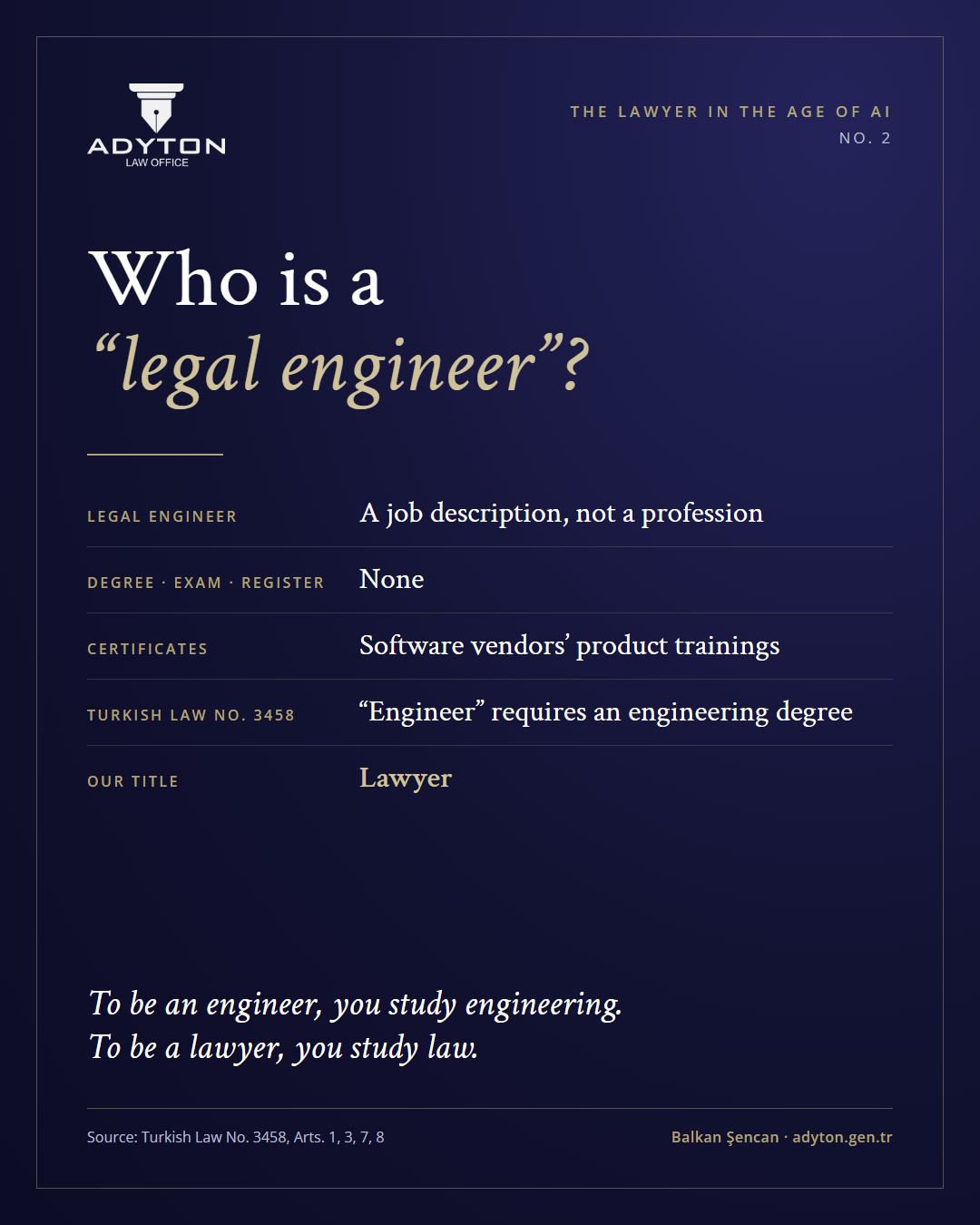
In other words, this is not a profession but a job description. Companies advertise positions under this name, but behind it there is no degree, no examination, no register and no professional body. Some of these roles do not even require a law degree. The best-known certificates bearing the name are software companies’ own product trainings; one of them takes about two hours and ends with a badge.
In Turkey the matter is even clearer. Law No. 3458 on Engineering and Architecture ties the title of engineer to an engineering degree. It provides that those without such a degree may not be employed under the title of engineer or sign as engineers, and it attaches a prison sentence of six months to two years to any breach. Whether the expression “legal engineer” falls within that scope is open to debate. What is not open to debate is this: the title rests on no degree and no authority whatsoever.
So what do we call a lawyer who uses AI well, automates workflows and checks model outputs?
The answer is simple: a lawyer.
We already have a title. We earned it through law school, our traineeship, our licence and our registration with the bar; behind it stand the Attorneyship Law and our rules of professional conduct. Do we really need to decorate it with a software company’s badge or with an epithet we have given ourselves? And where that epithet is used to create the impression, in the client’s eyes, of being “more than a lawyer”, the problem becomes greater still.
I leave aside colleagues abroad who hold a “Legal Engineer” position in a company; there, it is simply the name of a role. My point concerns lawyers in Turkey who freely use the title “engineer” without any engineering degree. The same question always comes to mind: Dear colleague, which faculty did you take your engineering degree from?
In my view, a lawyer’s value in the age of AI does not come from adopting new titles whose only merit is self-declared, but from developing their competence. Using AI tools well, seeing where they go wrong, building a workflow, staying in the driver’s seat and never handing the reins to these tools — these are the skills that truly matter. But they are not new professions that replace advocacy; they are new tools of a profession whose roots go back centuries.
To be an engineer, you need to study engineering. To be a lawyer, you need to study law. We have already done the second; if we also study the first and earn the degree, that is valuable. Until then, I leave the use of the title to your judgement. Our profession is already important and valuable enough.
Sources
- Law No. 3458 on Engineering and Architecture, Articles 1, 3, 7 and 8 (official Turkish text, mevzuat.gov.tr)
- Artificial Lawyer, “Lawyer to Trademark ‘Legal Engineer’, But Who Invented the Term?” (7 December 2017) – origins of the term
- Juro, “What is a legal engineer?” – the role, the skills and the absence of formal qualifications
- Harvey Academy, Legal Engineering Certification – an example of a vendor certificate (“about two hours”)